
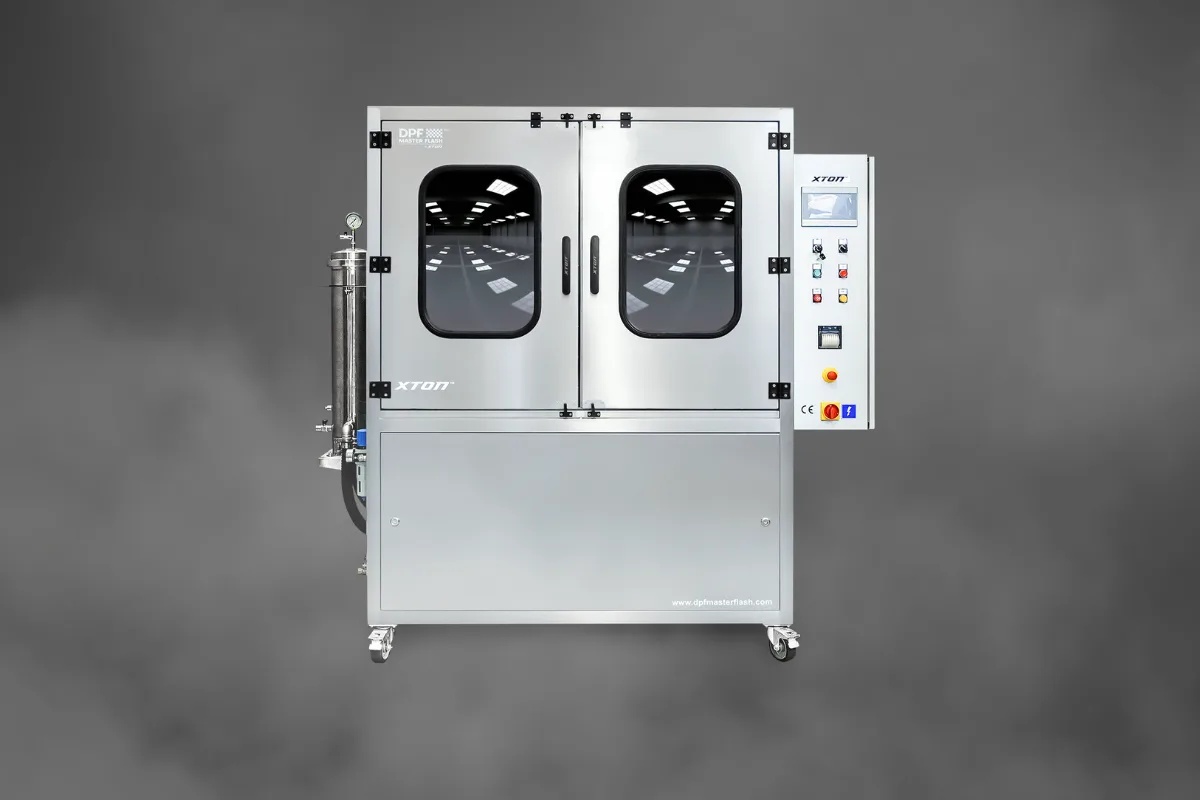
What does the particulate filter regeneration process look like?
During the regeneration process, the DPF Master Flash device forces water and air at high pressure into the interior of the particulate filter. The forces acting on the water particles cause a turbulent motion, in which the fluid particles move along colliding, often circular, trajectories. These produce a back-and-forth movement, causing them to collide and mix.
The next phenomenon that occurs during cleaning is cavitation, that is, the sudden change of the liquid’s state from the liquid phase to the gaseous phase as a result of the pressure difference. Thanks to these processes, the liquid passes smoothly through the narrow, clogged channels of the filter and removes all impurities, even those embedded in the micropores of the rough surface.
Unlike incineration in an induction furnace or immersing the filter in aggressive chemicals, only the hydrodynamic method guarantees a completely clean filter without damaging its ceramic structure: the very high temperatures of the induction furnace damage the filter monolith, and the ceramic likewise does not withstand well the direct action of aggressive chemicals.
To increase cleaning efficiency, we use the active cleaning product DPF Cleaner Extra Power, which, thanks to its unique formula, softens deposits of soot, ash, dust and other harmful substances, binding to the dirt particles and making them easier to remove.
Regeneration process with the DPF Master Flash device
- Connecting the filter to the device.
- Measuring the permeability test.
- Disconnecting the filter from the equipment.
- Applying the XTON DPF Cleaner Extra Power chemical.
- Reconnecting the filter to the device.
- Starting the cleaning process.
- Drying.
- Final back-pressure test.
- Printing the filter parameters.
Advantages of the device
- ISO and CE certificates: the device holds the CE certificate confirming its conformity with the directives and standards, and is manufactured in accordance with ISO standards.
- Functionality: the ergonomic design and intuitive interface allow simple use without the need for specialist knowledge.
- Design: the high aesthetics and attention to detail make XTON equipment stand out from the competition.
- Ecological solutions: the hydrodynamic regeneration process is completely safe for people and the environment.
- All in one: the device features an integrated system for hot-air drying and filter cooling, as well as permeability measurement and printing of the obtained parameters.
- Economy: low operating costs, around 7 € net per passenger vehicle and about 19 € net per commercial vehicle.
- Up to 99 % efficiency: effective cleaning of the particulate filter of soot, cerium oxide, oil deposits and heavy metals.
- Mobility: the Ethernet controller enables remote diagnostics of the device and software updates; the mobile app lets you monitor operation from your phone.
- Personalisation: the option to adapt the results printout with the workshop’s details or the vehicle model.